PARASOL ELITE POWER · MERCED COUNTY, CALIFORNIA
Sandy Mush Interactive Campus Map
Explore the proposed 10 MW Phase I AIDC, its independent power paths, integrated pyrolysis and carbon-management systems, provider-diverse fiber, community investments and low-net-water-use cooling strategy.
10 MW Phase I AIDC75 acres campus property2 × 800G AT&T + VAST
INTERACTIVE SITE PLAN
Select an asset or street view
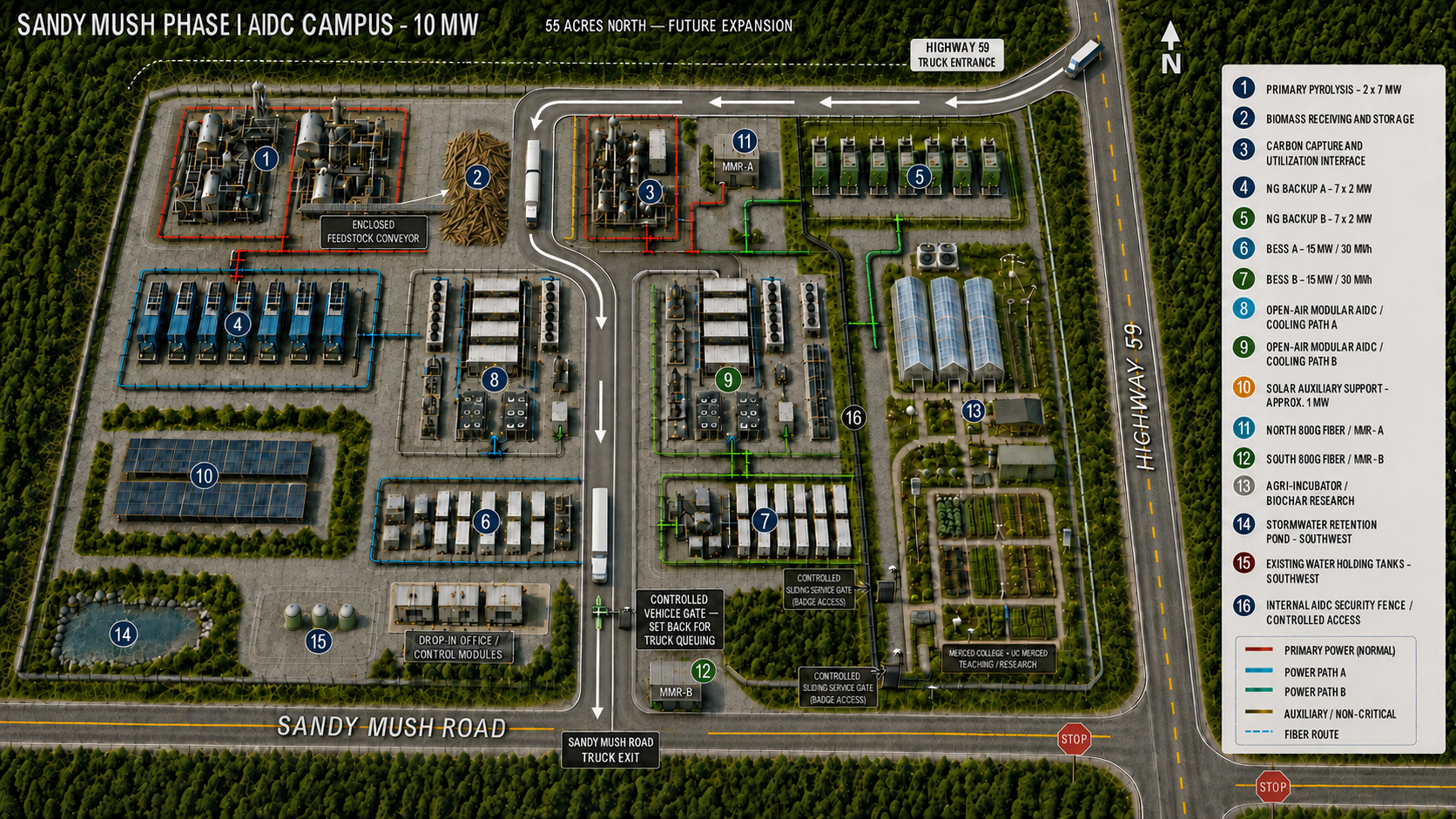
▣ Street view Select any numbered asset for its specifications, planning footprint and role in the Sandy Mush system. Electrical routing will be added after the detailed engineering layout is finalized.
PRELIMINARY PROJECT BUILDER
Build a preliminary project around your power source and available space
Set the project objective, generate a starting configuration, then adjust individual quantities. Results are conceptual screening values—not a quote, permit design, reliability certification or final engineering package.
Project inputs
Parasol system componentPlanning unitQty.Equipment area
7 MW Pyrolysis Module7 MW1.86 ac
2 MW NG Generator2 MW2.40 ac
5.015 MWh BESS Container2.5075 MW / 5.015 MWh0.80 ac
Ground-Mounted Solar Block1 MWdc0.94 ac
AIDC Solar Canopy Block1 MWdc0.20 ac
Absorption Chiller Module2 MWth planning basis0.48 ac
Closed-Circuit Cooling Tower2 MWth planning basis0.36 ac
Open-Air AIDC Block5 MW IT2.64 ac
Gross planning area applies a 24.14% campus allowance to component envelopes for circulation, service clearances and shared infrastructure. It excludes site-specific setbacks, substations, gas facilities, water systems, stormwater, offices, security, grading and other requirements that must be established by licensed engineers and authorities having jurisdiction.
HOW THE CAMPUS WORKS
Four coordinated layers, one behind-the-meter platform
Produce & recover
Integrated pyrolysis converts biomass into power, biochar and fertilizer while controlling the remaining emissions stream.
Collect & protect
Every generation source feeds the independent 15 MW / 30 MWh BESS A and/or BESS B paths. The batteries stabilize, protect and distribute all critical power.
Power compute
BESS A supplies only AIDC Path A and BESS B supplies only AIDC Path B. No primary or backup generator bypasses the batteries to reach compute.
Connect & reinvest
AT&T and VAST provide carrier-diverse 800G service; project revenue supports Merced manufacturing, education and agricultural R&D.